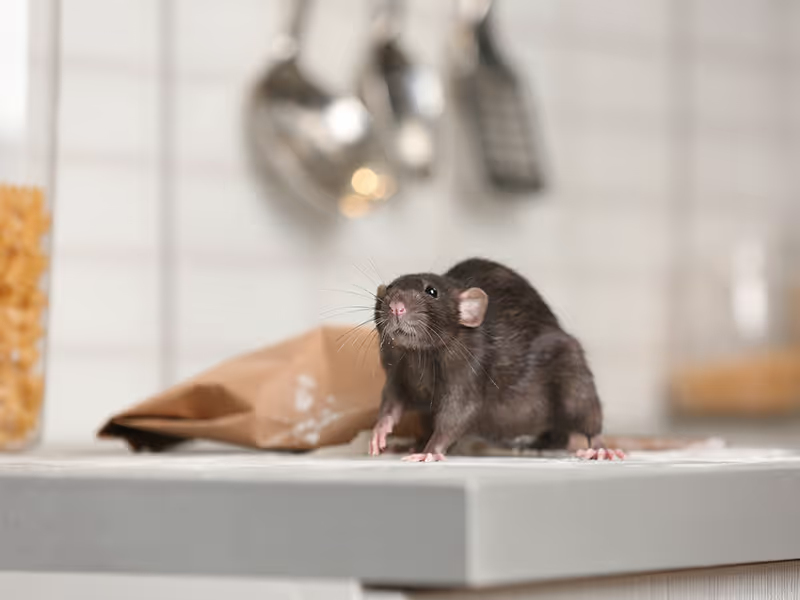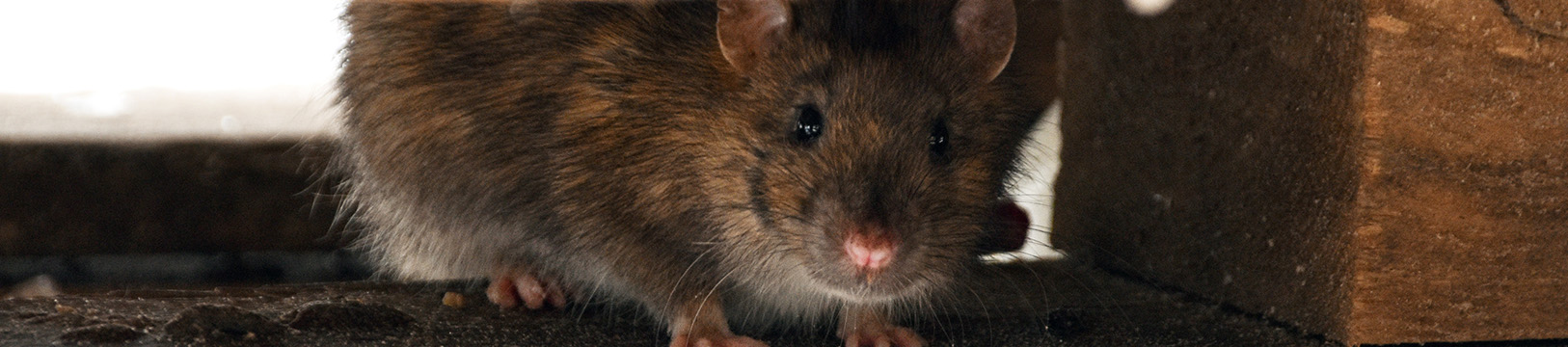
Norway rats are large, heavy-bodied rodents found throughout the Southeast, including Upstate South Carolina and Northeast Georgia. They are generally stockier than roof rats and are more strongly associated with ground-level and below-ground areas.
Outdoors, Norway rats commonly burrow near foundations, beneath slabs and decks, around sheds, and in other protected areas. Indoors, they may shelter in crawl spaces, basements, garages, lower wall voids, and other areas close to the ground.
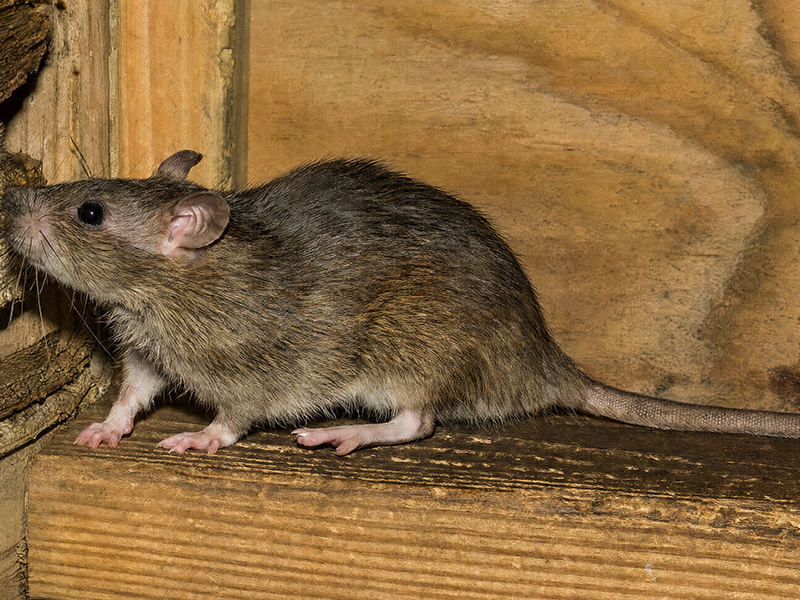
Norway rats have blunt noses, small ears, thick bodies, and scaly tails that are shorter than the combined length of the head and body.
Norway rats are active year-round in Northeast Georgia and Upstate South Carolina. Breeding can occur throughout the year, with reproductive activity often peaking in spring and fall. Rats may also become more noticeable around homes and other structures during the cooler months as they use protected areas for food and shelter, but Norway rat problems can occur in any season.
Quick ID
Norway rats are much larger and heavier than house mice.
House mice usually have smaller bodies, proportionally larger ears, and thin tails. Their droppings are also much smaller.
Norway rat droppings are typically about ½ to ¾ inch long and have blunt or rounded ends. Mouse droppings are closer to the size of a grain of rice and are usually pointed at one or both ends.
Mice can nest in locations throughout a structure, while Norway rats are more strongly associated with burrows, crawl spaces, basements, and other low areas.
Norway rats and roof rats are both found in the Southeast, but their appearance and behavior differ.
Norway rats have stockier bodies, blunt noses, smaller ears, and tails that are shorter than the head and body combined. They are commonly associated with burrows and ground-level areas.
Roof rats are slimmer, have more pointed noses and larger ears, and typically have tails that are longer than the head and body combined. They are stronger climbers and are more commonly found in attics, rooflines, trees, and other elevated areas.
Norway rats commonly establish burrows and nesting areas close to dependable food, water, and shelter.
Around homes, they may be found:
Norway rats are also associated with sewers and other underground environments.
Properties that provide food, water, shelter, or easy entry can support rat activity.
Common attractants include:
Norway rats are secretive, but their activity often leaves recognizable evidence.
Common signs include:
Burrow entrances are commonly several inches wide and may have freshly disturbed soil around the opening when they are actively being used.
Norway rats can damage property, contaminate food and surfaces, and create health concerns where they live and feed.
Potential problems include:
Avoid sweeping or vacuuming dry rodent droppings or nesting material.
Rodent-contaminated material should be thoroughly wetted with an appropriate disinfectant before cleanup, and rubber or plastic gloves should be worn when handling contaminated materials.
If droppings continue to appear after cleanup, there may still be active rodents nearby.
Norway rats often travel along established routes and can be cautious around unfamiliar objects, including newly placed traps.
Removing individual rats also does not address the conditions that allowed them to become established. Burrows, food sources, nesting areas, and openings into the structure may all need to be identified and addressed.
Professional rodent control can be especially helpful when activity continues, burrows are established around the structure, or rats are living in areas that are difficult to access.
Homeowners can reduce conditions that make a property attractive or accessible to rats by:
If you're finding Norway rat droppings, burrows, gnaw damage, or other signs of rodent activity, Compass Pest Management can help determine what is active around your home and where rodents may be getting in.
Compass Pest Management's ongoing home pest control plans include coverage for mice and rats, along with many other common household pests. Our company also provides commercial pest control for businesses facing rodent and other pest problems.
Locally owned and family-operated since 1995, Compass serves homes and businesses throughout Upstate South Carolina and Northeast Georgia.
Contact Compass Pest Management to request a quote.

Dale G has offered his expertise on a number of matters for our home: pest control, moisture control, moisture remediation, and insulation. I always leave the conversation feeling much more knowledgeable and having options. Dale makes us excited to contract Compass.
Anthony R.
Greenville, SC

Professional and friendly service! We are new to the area and happy we selected Compass for our pest control needs.
April Z.
Anderson, SC

I’ve been using Compass for over 5 years now for pest control and mosquito control and they do a great job. They are on time and always very professional. They are very accommodating if I ever needed anything else done like an ant problem in my kitchen.
Penny F.
Cornelia, GA



Helpful Tips & Info